
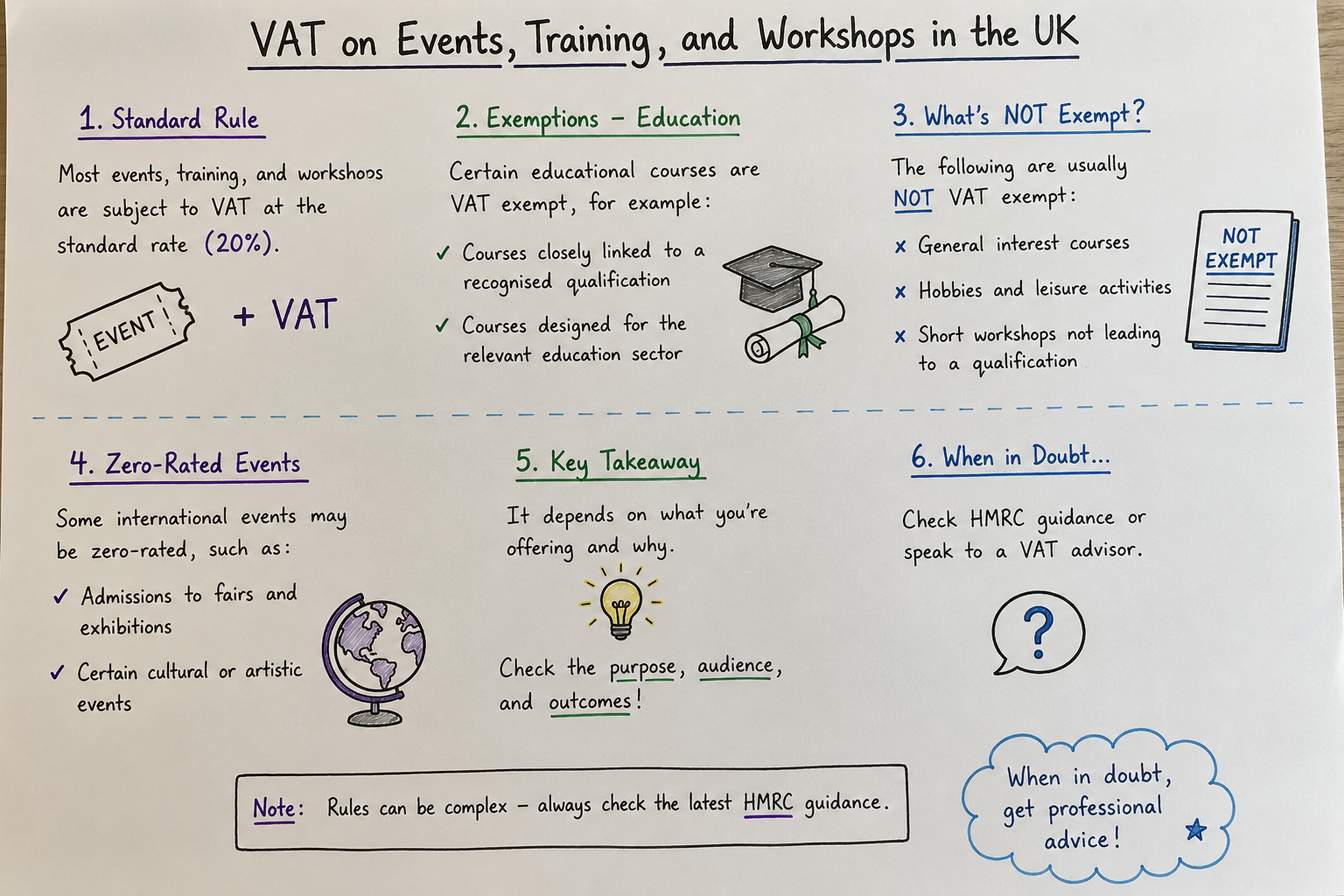
VAT on Events, Training and Workshops in the UK
VAT on events, training, and workshops often looks straightforward until the details are tested. A UK business sells a place on a seminar, charges delegates, pays a venue, provides refreshments, perhaps offers a recording afterwards, and assumes the VAT treatment follows the invoice total. In practice, HMRC usually looks at something more precise: what is being supplied, where it is supplied, who receives it, and whether the arrangement is education, admission to an event, consultancy, digital content, hospitality, or a mixture of several things.
That distinction matters. The VAT treatment of a one-day workshop in London may differ from an online course sold to overseas consumers. A professional conference may not be treated in the same way as private tuition. A training provider may be able to reclaim input VAT on venue hire, but may still misstate output VAT if it treats all training income as exempt. A charity may run an event for a social purpose and assume the VAT rules are more generous than they are.
This is where practical VAT work becomes less about memorising rates and more about understanding the commercial reality behind the supply.
Why events and training create more VAT questions than expected
Events and training sit across several VAT categories. They can involve education, admission, catering, printed materials, digital access, sponsorship, exhibition space, membership benefits, accommodation, overseas attendees and third-party platforms. The VAT position depends on the exact arrangement, not simply the label used on the invoice.
For example, describing something as a “workshop” does not automatically make it exempt education. Calling a charge a “conference fee” does not automatically mean it follows the same treatment as a ticket to a cultural event. A webinar may be live, interactive and adviser-led, or it may be automated digital content with very limited human involvement. Those differences can affect both UK VAT and, in cross-border cases, place of supply rules.
The most common search queries around this topic tend to include phrases such as VAT on training courses UK, VAT on workshops, VAT on event tickets, VAT on conferences UK, VAT exemption for education and training, VAT on online training, and VAT place of supply for events. They all point to the same underlying concern: businesses want to know whether VAT should be charged, where it should be accounted for, and what evidence should be retained.
Leave your details and our team will get back to you shortly.
The starting point: what exactly is being supplied?
Before considering VAT liability, the first practical question is whether the supply is a single supply or multiple supplies. This matters because event packages often bundle together items that may not have identical VAT treatment.
A delegate may pay one fee for access to a training day, course notes, lunch, CPD certification and a recording. From a commercial perspective, this is one product. From a VAT perspective, the analysis may ask whether there is one principal supply with ancillary elements, or separate supplies with separate VAT treatment.
In many cases, refreshments and course materials are merely incidental to the main training or event admission. But that is not always safe to assume. A premium retreat with accommodation, meals, entertainment and light business sessions may have a different character from a technical tax workshop where tea and printed notes are minor supporting elements.
Good VAT analysis starts with the customer’s perspective. What did the customer primarily buy? Access to an event? A taught course? A consultancy session? A networking experience? A digital product? A sponsorship opportunity? The answer drives the VAT treatment more than the marketing description does. Where the classification is uncertain, wider VAT compliance advisory can help frame the question around the supply rather than the wording used in marketing.
VAT on training courses: taxable, exempt or outside the ordinary assumption?
A frequent misconception is that training is automatically VAT exempt because it is “educational”. That is not correct. In the UK, education and vocational training can be exempt in certain circumstances, but the exemption is not available to every commercial training provider.
Broadly, exemption is more likely where the supplier is an eligible body, such as certain schools, universities, colleges, local authorities or other bodies meeting the relevant conditions. A private company providing professional training, business workshops or corporate learning will often be making standard-rated supplies unless a specific exemption applies.
This distinction catches out commercial trainers, consultants and coaching businesses. A limited company providing leadership workshops to corporate clients may view the content as educational, but HMRC may still regard the supply as standard-rated training. The subject matter alone is not enough. The status of the provider, the nature of the course and the legislative conditions all need to be considered.
There is also a difference between training and consultancy. A structured course delivered to a group may be training. A session designed around one client’s specific business issues may move closer to consultancy, even if it includes teaching. That distinction can affect not only VAT liability but also how the sale is described in contracts, proposals and invoices.
VAT on conferences, seminars and workshops
Conference and seminar fees are commonly standard-rated in the UK where the event takes place in the UK and no exemption applies. This includes many commercial business conferences, professional seminars, industry events and paid workshops.
The VAT position becomes more sensitive where the event includes several income streams. A conference organiser may receive:
- delegate ticket income;
- sponsorship fees;
- exhibitor stand charges;
- advertising income in event materials;
- catering recharges;
- recording access fees;
- membership or association fees linked to attendance.
These are not always the same supply. Sponsorship may involve promotional rights. Exhibition space may be a separate facility. Advertising may have its own place of supply considerations. A post-event recording may be digital content rather than attendance at the original event. Treating every income stream as “event income” can produce VAT errors that only become visible during bookkeeping review or HMRC enquiry.
For larger events, the operational issue is often not lack of VAT knowledge but poor mapping between the commercial system and the accounting records. Ticketing platforms, CRM systems, payment processors and bookkeeping software may all describe the same transaction differently. If those systems are not aligned, VAT return preparation becomes a reconstruction exercise rather than a controlled process.
Place of supply: the issue that changes the answer
VAT on events is not only about whether something is taxable. It is also about where the supply is treated as taking place. The place of supply rules are especially important where attendees, clients or customers are outside the UK.
For admission to events, the place of supply is often where the event physically takes place. This can mean that a UK organiser running an event in the UK may need to charge UK VAT on admission, even where the attendee is an overseas business. Conversely, an event held outside the UK may raise VAT registration or local tax obligations in another country, depending on the jurisdiction and circumstances.
Training can be more complex. B2B supplies of services may follow the general place of supply rule, where the customer belongs, but admission to an event is treated differently. The line between admission and training services is not always obvious. A public conference ticket sold to any delegate may be closer to admission. A bespoke course delivered to one overseas corporate client may need a different analysis.
Online delivery adds another layer. A live interactive webinar can have a different VAT analysis from pre-recorded automated access. If the customer is a consumer rather than a business, and especially if the customer is overseas, VAT rules may require more careful handling. For digital services supplied to EU consumers, UK businesses may need to consider non-UK VAT obligations and schemes such as VAT OSS registration where relevant.
Real-world scenarios that show the difference
A UK company runs a paid leadership workshop in Manchester
The provider is a commercial limited company. Delegates pay to attend a structured one-day workshop. Lunch and materials are included. In many cases, the supply is likely to be standard-rated if the provider is VAT registered and no exemption applies. The lunch and printed materials are usually part of the wider supply rather than separate items, but the facts should still be reviewed.
A professional body runs CPD training
The VAT position may depend on the body’s status, the nature of the training, whether it qualifies as education or vocational training, and whether any exemption conditions are met. Membership bodies should be particularly careful where event access is bundled with subscriptions, accreditation, publications or member-only benefits.
A UK trainer delivers a bespoke course to an overseas business client
The place of supply analysis becomes central. If the service is supplied B2B and is not admission to an event, the place of supply may be where the customer belongs. Evidence of the customer’s business status and location becomes important. The invoice wording should support the VAT treatment rather than obscure it.
A business sells pre-recorded course access to individuals in different countries
This may move away from ordinary training and towards electronically supplied services. The VAT answer can depend on where the customer is located and whether the customer is a business or consumer. For EU consumers, local VAT rules and reporting mechanisms may need to be considered.
A charity holds a fundraising dinner with a speaker and workshop session
The VAT treatment may depend on whether the event qualifies for a charity fundraising exemption, whether the event is advertised as fundraising, the frequency of such events, what is included in the ticket price, and whether attendees receive more than incidental benefits. Charities often have additional reliefs and exemptions available, but the conditions are specific and should not be assumed.
What businesses often get wrong
The first common mistake is treating VAT as an afterthought. The event is priced, marketed, sold and delivered before anyone checks the VAT position. By the time the issue reaches the accounts team, the ticket price may already be commercially fixed. If VAT should have been charged but was not, the organiser may have to absorb the VAT cost from the gross income.
The second mistake is relying on the description used by competitors. If another provider sells similar workshops without VAT, that does not prove the treatment is correct. They may be below the VAT registration threshold, eligible for an exemption, operating through a different type of body, or simply wrong.
The third mistake is failing to separate B2B and B2C sales. VAT evidence for a business customer is not the same as evidence for a consumer. For cross-border supplies, customer status and location can change the treatment. A checkout form that collects a name and email address but not business status, VAT number or address may leave gaps in the audit trail.
The fourth mistake is ignoring partial exemption. If a provider makes both taxable and exempt supplies, input VAT recovery may be restricted. This can affect venue costs, marketing costs, software subscriptions, professional fees and overheads. The issue may not be obvious until VAT returns are prepared or year-end accounts are reviewed.
VAT registration and the hidden impact of event income
Event and workshop income can push a business over the VAT registration threshold faster than expected. This is particularly common where a trainer or consultant has historically sold services below the threshold, then launches a successful course, conference or online programme.
The VAT registration test looks at taxable turnover, not profit. A business may incur substantial venue, advertising and speaker costs, but gross taxable income still counts for threshold purposes. Exempt income may be excluded from taxable turnover, but only where it is genuinely exempt. Misclassifying standard-rated training as exempt can lead to missed VAT registration obligations.
There is also a timing issue. The registration threshold is assessed on a rolling basis, not just at the financial year end. Businesses that rely only on annual accounts may identify the obligation late. By then, invoices may have been issued without VAT, customer contracts may not allow VAT to be added retrospectively, and pricing may need to be corrected.
VAT deregistration can also be relevant where event activity was temporary. A business that registered because of a one-off programme may later fall below the deregistration threshold. The decision should still be considered carefully, because deregistration affects input VAT recovery, customer pricing, and the VAT treatment of assets or stock in certain cases.
Input VAT recovery: venue costs, platforms and event overheads
Organisers often focus on output VAT charged to customers, but input VAT recovery can be just as important. Venue hire, catering, marketing, ticketing platforms, speaker fees, AV production and software subscriptions may all include VAT. Whether that VAT is recoverable depends on the VAT status of the organiser and the nature of the supplies being made.
If the event income is standard-rated, input VAT recovery is usually more straightforward, subject to normal VAT rules and valid VAT invoices. If the income is exempt, recovery may be restricted. If the business has both taxable and exempt activities, partial exemption calculations may be required. For organisers reviewing supplier VAT and recoverable costs, VAT reclaim and refunds considerations are often inseparable from the event’s income treatment.
There are also practical documentation issues. A booking confirmation from a venue is not always a VAT invoice. A payment processor report is not necessarily enough evidence to support input VAT recovery. Overseas supplier invoices may require reverse charge treatment. Platform fees may be deducted before funds reach the bank, which can cause income and VAT to be recorded net rather than gross.
These are bookkeeping issues as much as tax issues. If the finance process does not capture VAT evidence at the point of purchase or sale, the VAT return becomes dependent on assumptions. That increases the risk of errors and makes later review more expensive.
Online training, webinars and recordings
Online training is not a single VAT category. The VAT treatment can depend on how much human involvement exists, whether the session is live or automated, where the customer is located, and whether the customer is a business or consumer.
A live workshop delivered over video, with interaction, tutor involvement and scheduled attendance, may be closer to a training service. A library of pre-recorded modules available immediately after payment may be closer to a digital service. A hybrid model with live sessions, recordings, downloadable materials and community access may require more careful analysis.
The distinction matters for overseas sales. Digital services supplied to consumers in other jurisdictions can create VAT obligations outside the UK. Businesses selling courses internationally should not assume that being UK-based makes all sales subject only to UK VAT. Nor should they assume that using a platform removes all responsibility; the platform’s role depends on whether it is acting as agent, disclosed agent, undisclosed agent, reseller or marketplace operator.
From an operational perspective, online course businesses need checkout systems that collect the right data. Customer location, business status, VAT number where applicable, billing address, IP evidence and terms of sale may all become relevant. Retrofitting this after sales have started is rarely tidy.
Events involving overseas delegates or overseas venues
International events introduce two separate questions. First, does UK VAT apply? Second, does another country’s VAT or sales tax regime apply? Answering the first question does not answer the second.
A UK business organising a conference in an EU country, for example, may need to consider local VAT rules in the country where the event is held. It may also need to decide whether local registration is required, whether a reverse charge mechanism applies for certain supplier costs, and how delegate invoices should be issued.
For UK events attended by overseas delegates, the place of supply rules for admission can still bring the supply within UK VAT. Some overseas businesses may expect no UK VAT because they are not UK-established, but event admission rules can produce a different result. Clear invoice wording and pre-event communication help reduce disputes.
VAT recovery for overseas delegates is a separate matter. A customer may be able to reclaim VAT through refund mechanisms depending on their country, status and the nature of the cost. That does not necessarily change the organiser’s obligation to charge VAT correctly.
Record keeping HMRC will expect to see
VAT treatment should be supported by records, not just remembered reasoning. For events, training and workshops, useful records often include:
- event agendas, brochures and sales pages showing what was supplied;
- contracts or booking terms with delegates, sponsors and exhibitors;
- evidence of customer status, especially for B2B overseas sales;
- customer location evidence for online and cross-border supplies;
- VAT invoices from venues, suppliers and platforms;
- ticketing reports reconciled to bank receipts and accounting entries;
- working papers explaining any exemption, reverse charge or place of supply treatment;
- partial exemption calculations where taxable and exempt income are mixed.
These records matter because VAT enquiries often happen months or years after the event. Staff may have changed, landing pages may have been removed, and platform reports may no longer be easy to access. If the VAT position depends on the nature of the supply, the evidence should preserve that context.
The pricing problem: VAT-inclusive or VAT-exclusive?
Pricing is one of the more practical reasons to resolve VAT early. B2B events are often priced plus VAT because business customers may be able to reclaim VAT. Consumer-facing workshops are usually marketed with VAT-inclusive pricing. Problems arise when the pricing approach does not match the audience.
If a VAT-registered organiser advertises a public workshop at £250 without clarifying VAT, the customer may assume that £250 is the total price. If the organiser later adds VAT at checkout, conversion may fall or complaints may follow. If the organiser absorbs VAT within the £250, margin may reduce materially.
For mixed audiences, the issue is more sensitive. A professional development course may attract sole traders, limited companies, employees paying personally, overseas businesses and private individuals. The checkout process must handle VAT treatment without creating confusion or inconsistent records.
Terms and conditions should also say whether prices are VAT-inclusive or VAT-exclusive. This is not merely a legal drafting point. It affects finance, customer service, invoicing, refunds and management accounts. If refunds are processed after a VAT return has been submitted, credit notes and VAT adjustments need to be handled correctly.
Accounting and management reporting implications
VAT errors in events and training rarely stay confined to the VAT return. They can distort management accounts, gross margin analysis and profitability by product line. A workshop may appear profitable because income is recorded gross and VAT has not been recognised as a liability. Later correction can turn the same event into a weaker commercial result.
Event businesses also tend to receive advance payments. VAT tax points and deferred income accounting are not the same issue. A business may recognise revenue in its management accounts when the event takes place, but VAT may become due earlier depending on invoicing and payment timing. This difference needs to be understood rather than accidentally smoothed out.
For companies, directors remain responsible for ensuring that tax filings are accurate and that accounting records are adequate. Companies House accounts may not show the VAT detail, but poor VAT controls can still affect statutory accounts, corporation tax computations and cash flow reporting. The board may believe it is reviewing event profitability when, in reality, VAT liabilities and deferred income have not been properly separated.
Payroll, CIS and staffing edges
Events and workshops can also touch payroll and employment tax issues. Speakers, trainers, facilitators and event staff may be employees, workers, self-employed contractors or supplied through agencies. VAT treatment of the event income is separate from payroll status, but the operational records often overlap.
If trainers are paid as self-employed individuals, the business should consider whether the arrangement is properly documented and whether employment status has been reviewed. If a company supplies trainers, VAT may be charged on the supplier invoice. If temporary staff are provided through an agency, the invoice may include VAT on the agency’s supply. These costs feed into input VAT recovery and event margin calculations.
CIS is less common in ordinary training and conference activity, but it may appear around exhibition build, stage construction or venue fit-out work. Where construction operations are involved, the organiser should not assume the issue is irrelevant simply because the main activity is an event. The scale and nature of the works determine whether CIS questions arise.
A practical workflow before launching an event or course
The strongest VAT position is usually built before sales begin. A practical pre-launch review does not need to be bureaucratic, but it should answer the questions that later determine VAT treatment.
- Define the supply: identify whether customers are buying admission, training, consultancy, digital content, sponsorship rights or a package.
- Identify the supplier: confirm which legal entity is contracting with customers and whether it is VAT registered or approaching the threshold.
- Classify customers: decide whether sales are B2B, B2C or mixed, and what evidence will be collected.
- Map locations: establish where the event takes place, where customers belong, and whether online access changes the analysis.
- Review exemptions: consider whether education, vocational training, charity fundraising or another exemption is genuinely available.
- Set pricing correctly: decide whether prices are VAT-inclusive or VAT-exclusive before marketing begins.
- Configure systems: make sure ticketing, checkout, invoicing and bookkeeping systems apply VAT consistently.
- Retain evidence: keep event materials, contracts, invoices and VAT reasoning in a form that can be reviewed later.
This workflow is particularly useful for businesses launching a new training product. The first version of a course often evolves quickly: early bird pricing, corporate bundles, affiliate sales, international access and recordings may be added after the initial launch. Each change can alter the VAT profile.
Once the treatment is decided, it needs to flow into bookkeeping and VAT filing: output VAT on sales, input VAT on costs, credit notes for cancellations, platform fees, reverse charge entries where relevant, and Making Tax Digital-compatible records.
Questions worth asking before deciding the VAT treatment
A well-framed VAT review is usually more effective than a search for a single yes-or-no answer. Before deciding whether VAT applies to an event, training course or workshop, businesses should ask:
- Is the provider an eligible body for education exemption purposes, or an ordinary commercial supplier?
- Is the customer buying attendance at an event, structured training, consultancy or digital access?
- Is the event held in the UK or overseas?
- Are customers businesses, consumers or a mixture of both?
- Are overseas customers involved, and is evidence of their location and status retained?
- Are sponsorship, exhibitor fees or advertising income being treated separately?
- Does the business make exempt as well as taxable supplies?
- Will the income affect VAT registration or deregistration decisions?
- Can the accounting system reconcile ticket sales, platform fees, refunds and VAT?
The answers may not always produce a difficult technical conclusion. Often they reveal a process weakness: missing customer data, unclear terms, inconsistent invoices, or sales systems that were not configured for VAT before transactions began.
Key VAT risks for event and training providers
The highest-risk situations are not always the largest events. Small providers can face disproportionate issues because systems are informal and the same person may handle marketing, sales, delivery and bookkeeping.
Risk increases where a business:
- sells to overseas customers without collecting location or business status evidence;
- assumes all training is exempt from VAT;
- uses ticketing platforms without checking how VAT is reported;
- records net receipts rather than gross ticket income and platform fees;
- runs both exempt and taxable activities without considering partial exemption;
- launches online course content internationally without reviewing digital VAT rules;
- exceeds the VAT registration threshold unexpectedly after a successful event launch;
- treats sponsorship and exhibitor income as if it were delegate ticket income;
- fails to issue credit notes or adjust VAT correctly after cancellations and refunds.
None of these automatically means a business has a serious compliance failure. They are, however, signals that the VAT process needs attention. HMRC is generally more interested in whether a business has taken reasonable care, kept proper records and applied a supportable treatment than in whether every commercial arrangement fits a simple category.
How to think about VAT without overcomplicating the business
There is a balance to strike. Over-engineering VAT processes for a small local workshop may be unnecessary. Ignoring VAT on a fast-growing online training platform selling internationally is equally unwise. The level of review should match the complexity and risk of the activity.
A local VAT-registered business running occasional UK workshops may only need clear pricing, correct VAT invoices and reliable bookkeeping. A training provider selling subscriptions, live sessions and recordings to customers across several countries needs a more structured VAT design. A charity or professional body may need to document why an exemption applies and how mixed income streams are treated.
The most mature businesses treat VAT as part of product design rather than an accounting clean-up exercise. They ask VAT questions before launching the offer, not after the first VAT return is due. That approach protects margin, reduces customer disputes and makes reporting more reliable. For broader context on UK VAT treatment and compliance, it is useful to connect the event decision with registration, invoicing, recovery and return processes rather than viewing each point separately.
Practical takeaways
VAT on events, training and workshops in the UK depends on the specific supply, supplier status, customer type and place of supply. The word “training” does not automatically create exemption. The word “event” does not remove the need to consider overseas customers, digital access or bundled income streams.
For UK businesses, the practical priorities are clear:
- identify the real nature of the supply before sales begin;
- check whether VAT exemption genuinely applies rather than assuming it;
- monitor VAT registration thresholds where event income is growing;
- collect customer status and location evidence for cross-border sales;
- separate delegate income, sponsorship, exhibitor fees and digital content where necessary;
- ensure ticketing and accounting systems record VAT correctly;
- retain evidence that supports the VAT treatment applied.
VAT errors in this area usually arise from commercial speed rather than deliberate non-compliance. Events are launched quickly, training products evolve, online platforms expand reach, and accounting records are asked to explain decisions that were never formally made. A little VAT thinking at the design stage can prevent a much larger correction later.
Final perspective
The VAT rules for events, training and workshops are not designed around how modern businesses package learning and experiences. They separate supplies by legal character, place of supply, customer status and exemption conditions, while the market sells blended products: live sessions, recordings, communities, accreditation, networking, hospitality and international access.
That gap between commercial reality and VAT classification is where mistakes happen. The safest approach is not to force every offer into a convenient label, but to examine what the customer is actually buying, where the supply is treated as taking place, and what evidence would support the decision if HMRC asked later.
For providers, organisers, charities, professional bodies and online educators, VAT should be treated as part of the operating model. It affects pricing, systems, contracts, bookkeeping, cash flow and reporting. Getting the treatment right is not only a compliance exercise; it is part of understanding whether the event or training product is commercially sound once tax is properly accounted for.