
File Dormant Company Accounts
Leave your details and our team will get back to you shortly.
If your UK limited company is dormant, you will normally still need to file annual accounts with Companies House. We can review the company’s position, prepare the appropriate dormant accounts and handle the Companies House filing on your behalf.
Our dormant company accounts filing service starts from £150 + VAT for straightforward cases. Before preparing anything, we check that dormant accounts are appropriate for the financial period. That matters because having no sales does not, by itself, make a company dormant.
If the company has previously traded, has transactions that need reviewing, has overdue accounts or requires separate HMRC work, the scope may be different. We will identify this before additional work is undertaken.
Dormant Company Accounts Filing Service
For Companies House purposes, a company is dormant if it has had no significant accounting transactions during the financial year. Certain items are disregarded, including Companies House filing fees, late filing penalties and money paid for shares when the company was incorporated.
Where the company qualifies, our service can cover the review of its dormant position, preparation of the appropriate accounts, director approval and submission to Companies House.
For a straightforward dormant company, the service from £150 + VAT is intended to cover the standard accounts preparation and filing process. Additional work may be required where, for example, the company previously traded, historic filings need attention, transactions require investigation or separate Corporation Tax matters need to be dealt with.
The aim is not simply to submit a form. We first establish what should be filed.
Can You File Dormant Company Accounts?
 Dormant accounts may be appropriate where a limited company has had no significant accounting transactions during the relevant financial year. A newly incorporated company that has never started trading is a common example.
No turnover does not necessarily mean no accounting activity. Income, expenses, bank movements, asset purchases or other transactions may need to be considered before deciding whether dormant accounts are suitable.
Equally, not every movement automatically prevents dormant treatment. The facts of the accounting period matter, which is why we check the position rather than relying solely on whether the company made sales.
How to File Dormant Company Accounts with Companies House
All limited companies must generally deliver annual accounts to Companies House, including dormant companies. Companies that meet the relevant requirements can prepare simpler dormant accounts.
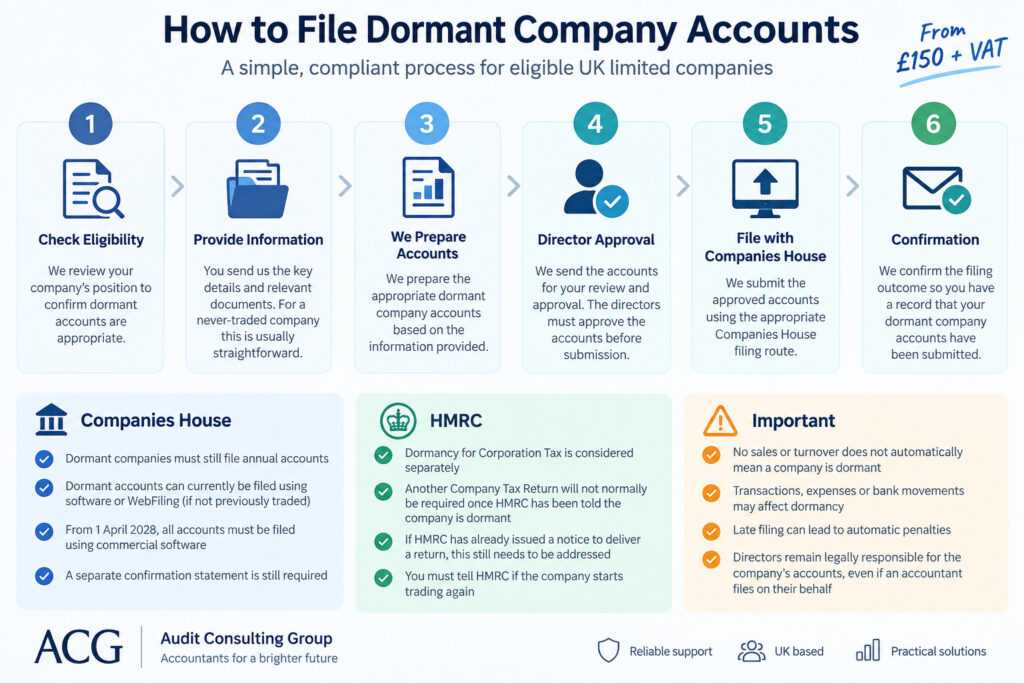
The filing process involves establishing the company’s position for the accounting period, preparing the appropriate accounts, obtaining director approval and delivering them to Companies House through a permitted filing route.
Dormant accounts can currently be filed using compatible software. Companies House also currently provides WebFiling for dormant accounts where the company has not previously traded. From 1 April 2028, Companies House will require annual accounts to be filed using commercial software, and the existing web and paper accounts filing routes will close.
If a company is dormant and has not traded since incorporation, the AA02 paper form can also currently be used in qualifying circumstances. It is not suitable for every dormant company, including companies that became dormant after previously trading. If you are unsure which route applies, we can check this as part of the initial review.
For a broader explanation of the Companies House filing process, see our Companies House annual accounts filing service.
What We Check Before Filing Your Dormant Accounts
 A filing can look straightforward until the company’s history is examined. We therefore start with the accounting period and the activity that took place during it.
Depending on the circumstances, we may review the incorporation date, accounting reference date, previous accounts, trading history, share capital, bank activity and any transactions recorded during the year. For a company that has genuinely never traded, the review is usually much simpler.
If something indicates that dormant accounts may not be appropriate, we will explain the issue before filing. The company may need a different form of annual accounts or additional work may be required to deal with an earlier period.
What Information Do We Need From You?
We keep the information request proportionate to the company. A straightforward never-traded company will usually require less documentation than a business that operated previously or has activity that needs to be reviewed.
- Company name and registration number.
- The relevant accounting period.
- Confirmation of whether the company has ever traded.
- Details of any income, expenses or other transactions during the period.
- Previous accounts, where relevant.
- Bank information if activity needs to be checked.
- Share and share capital information where applicable.
- The Companies House authentication code or other filing information where required.
If we need anything else after reviewing the initial information, we will ask for it before the accounts are finalised.
Filing Dormant Company Accounts Online
Eligible dormant company accounts can currently be filed online with Companies House. The online process includes checks intended to reduce common filing errors.
Companies House WebFiling requires the relevant login details and company authentication code. If a new authentication code is needed, Companies House sends it by post, so this should be allowed for when a filing deadline is approaching.
Where we handle the filing, we prepare the accounts from the information supplied, provide them for the necessary review and approval, and submit them once the filing requirements have been satisfied.
Filing Accounts for a Company That Has Never Traded
Companies are often incorporated before a business is ready to launch. A project may be delayed, funding may not proceed, or the company may simply be retained for future use.
If the company has never traded and has had no significant accounting transactions, dormant accounts may be appropriate. It does not, however, mean the company can simply be ignored. While it remains registered, annual accounts and a confirmation statement will normally continue to be required.
This is usually one of the more straightforward dormant filing situations, provided there has been no activity that changes the company’s status.
What If Your Company Has Traded Before?
 A company can trade and later become dormant. The important point is to separate its earlier trading activity from the subsequent dormant period correctly.
If the company previously operated, we may need to review its last trading period, previous accounts and the point at which activity stopped. A company that is dormant today cannot simply treat earlier trading periods as though they were dormant as well.
The filing route may also differ. For example, the current Companies House WebFiling option for dormant accounts is available where the company has not previously traded, while companies that became dormant after trading may need dormant accounts prepared and filed through another appropriate route.
Previous trading therefore does not automatically prevent future dormant status, but it can make the accounting and filing position less straightforward.
Companies House and HMRC: What Do You Actually Need to File?
Companies House dormancy and HMRC dormancy are related, but they are not the same compliance process.
For Companies House, the focus is on whether the company had significant accounting transactions during the financial year. A dormant company must normally continue to file annual accounts and confirmation statements.
HMRC considers whether the company is dormant for Corporation Tax. A new company that has not started trading, or a company that has stopped trading and has no other income, may be dormant for Corporation Tax depending on its circumstances.
Once HMRC has been told that a company is dormant, another Company Tax Return will not normally be required unless HMRC issues a further notice to deliver one or the company starts trading again. If a notice to deliver a Company Tax Return has already been issued for a period, that filing requirement still needs to be dealt with.
This is why filing dormant accounts at Companies House should not be treated as automatically resolving the company’s HMRC position.
Can You File Dormant Company Accounts Yourself?
Yes. Directors can deal with straightforward dormant accounts themselves where the company qualifies and they are comfortable with the requirements.
Professional support tends to be more useful when there is uncertainty: perhaps the company traded previously, there have been bank movements or expenses, an earlier filing is outstanding, or the director is not sure whether the company meets the dormant conditions.
Using an accountant does not transfer the directors’ legal responsibilities for the company’s accounts. The directors remain responsible for ensuring that the accounts are prepared properly and must approve them before they are filed.
Our role is to make the process clearer, check the accounting position and handle the preparation and filing based on the information provided.
Our Dormant Accounts Filing Process
1. Initial Company Check
We establish the accounting period, review the company’s history and identify whether anything needs to be considered before dormant accounts are prepared.
2. Information Collection
We request the records relevant to the company. For a simple never-traded company this may be limited; a company with previous activity may require a more detailed review.
3. Accounts Preparation
Once the position is clear, we prepare the appropriate dormant company accounts using the information supplied.
4. Director Review and Approval
The accounts are provided for review and approval. Any questions identified at this stage can be dealt with before submission.
5. Companies House Filing
After approval and once the necessary filing access is available, we submit the accounts through the appropriate Companies House filing route.
6. Filing Confirmation
We confirm the submission and filing outcome so that you have a record of what has been dealt with.
Timing depends on the company’s circumstances, the completeness of the information provided, director approval and the availability of any required Companies House authentication details. If a deadline is close, tell us at the outset so we can assess what is realistically possible.
What Happens After Your Dormant Accounts Are Filed?
Filing dormant accounts does not close the company. If it remains registered, its future statutory obligations continue.
A confirmation statement is a separate Companies House filing, so submitting the accounts does not deal with that requirement automatically.
If the company remains dormant, future annual accounts will normally still be required. If it starts trading again, HMRC must be told so that the company can be brought back within the Corporation Tax regime, and future accounts will need to reflect its activity.
Dormant Company Accounts Filing Deadlines
Keeping a company dormant does not remove its annual Companies House filing obligations. The exact deadline depends on whether these are the company’s first accounts or a later annual filing.
| Filing situation | Companies House deadline | What it means in practice |
|---|---|---|
| First accounts – private limited company | Usually 21 months after incorporation | A newly incorporated company normally has longer to file its first set of accounts. |
| First accounts covering more than 12 months | 21 months from incorporation or 3 months from the accounting reference date, whichever is longer | Special rules apply where the first accounting period is longer than 12 months. |
| Subsequent annual accounts | 9 months after the end of the accounting reference period | This is the standard Companies House deadline for a private limited company. |
| Dormant private limited company | Normally the same annual filing deadline | Dormant status does not remove the requirement to file annual accounts with Companies House. |
| Confirmation statement | Separate from the accounts deadline | Filing dormant accounts does not satisfy the company’s confirmation statement obligation. |
Important: always check the company’s actual filing deadline on the Companies House register. Changing an accounting reference date or other circumstances can affect the filing period.
Common Dormant Accounts Filing Problems
The filing itself is often not the difficult part. Problems usually arise because the company’s position was assumed rather than checked.
Typical issues include treating “no sales” as proof of dormancy, overlooking transactions during the year, confusing HMRC dormancy with Companies House dormancy, or discovering too late that previous accounts are outstanding.
Timing matters too. Dormant accounts have filing deadlines, and late filing can lead to Companies House penalties. If the deadline is approaching, it is better to establish the position early enough to deal with any unexpected issues.
For detailed timing information, see our guidance on Dormant Company Accounts Deadlines.
Companies House Late Filing Penalties
Dormant companies are not exempt from late filing penalties. If annual accounts reach Companies House after the deadline, an automatic penalty can apply even where the company has not traded.
| How late the accounts are | Private company penalty | If late in 2 successive financial years | Practical impact |
|---|---|---|---|
| Not more than 1 month | £150 | £300 | A relatively short delay can still trigger an automatic financial penalty. |
| More than 1 month but not more than 3 months | £375 | £750 | The penalty increases significantly once the filing is more than one month late. |
| More than 3 months but not more than 6 months | £750 | £1,500 | A prolonged delay can cost considerably more than dealing with the filing before the deadline. |
| More than 6 months | £1,500 | £3,000 | This is the highest standard late filing penalty for a private limited company. |
Important: the late filing penalty is doubled where accounts are filed late in two successive financial years. Dormant status itself is not normally a valid reason for appealing a late filing penalty.
Typical Dormant Company Filing Situations
A Company Incorporated for a Business That Never Launched
A director may set up a limited company for a planned venture and then postpone the project before trading begins. We would first check whether there had been any activity affecting dormancy. Where the company remained dormant, the practical outcome would be a set of appropriate accounts prepared for approval and filing while the company remained registered for possible future use.
A Previously Active Company That Stopped Trading
Where a business has traded before, the starting challenge is different. The previous trading period and the later dormant period need to be distinguished rather than treating the company’s entire history as dormant. Reviewing the earlier accounts and cessation of activity allows the appropriate filing position for the subsequent period to be established.
A Company With No Sales but Some Financial Activity
A director may believe the company is dormant because it generated no turnover, while the records show payments or other activity during the year. In that situation, we would review what actually happened before choosing the filing route. The practical outcome is clarity on whether dormant accounts are appropriate or whether another form of annual accounts is needed, reducing the risk of submitting on the wrong basis.
Related Dormant Company Accounts Services
If you first need to understand the wider rules, our Dormant Company Accounts hub explains how Companies House and HMRC treat dormancy and what obligations can continue while the company is inactive.
You can also review Dormant Company Accounts Cost for pricing information, Dormant Company Accounts Deadlines for filing dates and late-filing considerations, and AA02 Dormant Company Accounts for the circumstances in which that filing route may be relevant.
If the company does not qualify for dormant accounts, our Annual Accounts service covers the wider year-end accounts process.
Frequently Asked Questions
How do I file dormant company accounts with Companies House?
First establish that dormant accounts are appropriate for the financial year. The accounts then need to be prepared, approved by the directors and delivered to Companies House using an available filing route. We can review the position and handle the preparation and submission for you.
Can dormant company accounts be filed online?
Yes. Dormant accounts can currently be filed using compatible software, and Companies House WebFiling is available where the company has not previously traded. From 1 April 2028, annual accounts will need to be filed using commercial software.
Can I file dormant company accounts myself?
Yes. A director can deal with the filing where the company qualifies and the position is straightforward. If there is previous trading, financial activity, an overdue period or uncertainty about dormancy, professional review may be useful before filing.
What information do you need to file my dormant accounts?
Usually we need the company details, accounting period, trading history and information about activity during the year. Previous accounts, bank information or other records may be needed depending on the company’s circumstances.
Can you file dormant accounts for a company that has never traded?
Yes, subject to checking the company’s position. A company that has never traded and has had no significant accounting transactions is a common dormant filing situation.
What if my company traded before becoming dormant?
A previously active company can become dormant, but its earlier trading periods and subsequent dormant period need to be treated correctly. The filing route and amount of review required may therefore differ from a company that has never traded.
Do I file dormant company accounts with HMRC as well?
Dormant accounts are filed with Companies House. HMRC has separate rules for companies that are dormant for Corporation Tax. Depending on the circumstances, HMRC may need to be notified, and an existing notice to deliver a Company Tax Return still needs to be addressed.
Does filing dormant accounts also file the confirmation statement?
No. Annual accounts and the confirmation statement are separate Companies House requirements. Filing one does not satisfy the other.
File Your Dormant Company Accounts
If your company is dormant and you would prefer the accounts to be checked, prepared and filed professionally, Audit Consulting Group can handle the process from the initial review through to Companies House submission.
Our service starts from £150 + VAT for straightforward dormant company accounts. If previous trading, historic filings, transactions or separate HMRC work mean the scope is wider, we will identify that before additional work is undertaken.
Contact us with your company details to get started.
Service Cost Estimation
Select the service category below to calculate the estimated cost of either accounting & tax services or forms and submissions.
Select Required Services / Forms
Select one or more services/forms to receive an accurate cost estimate. You can adjust your selection at any stage.
How would you like to engage our services?
Please select whether you require a one-off service or ongoing monthly support.
Contract Duration
Your cost estimate
Apply now and get 10% OFF
Submit your request today and receive an exclusive 10% discount on your selected service.
All prices are estimates. To receive a personalised quote, please fill out the form or contact us.
Ready to get started?
Get professional support from experienced UK accountants